

Monumento Mori

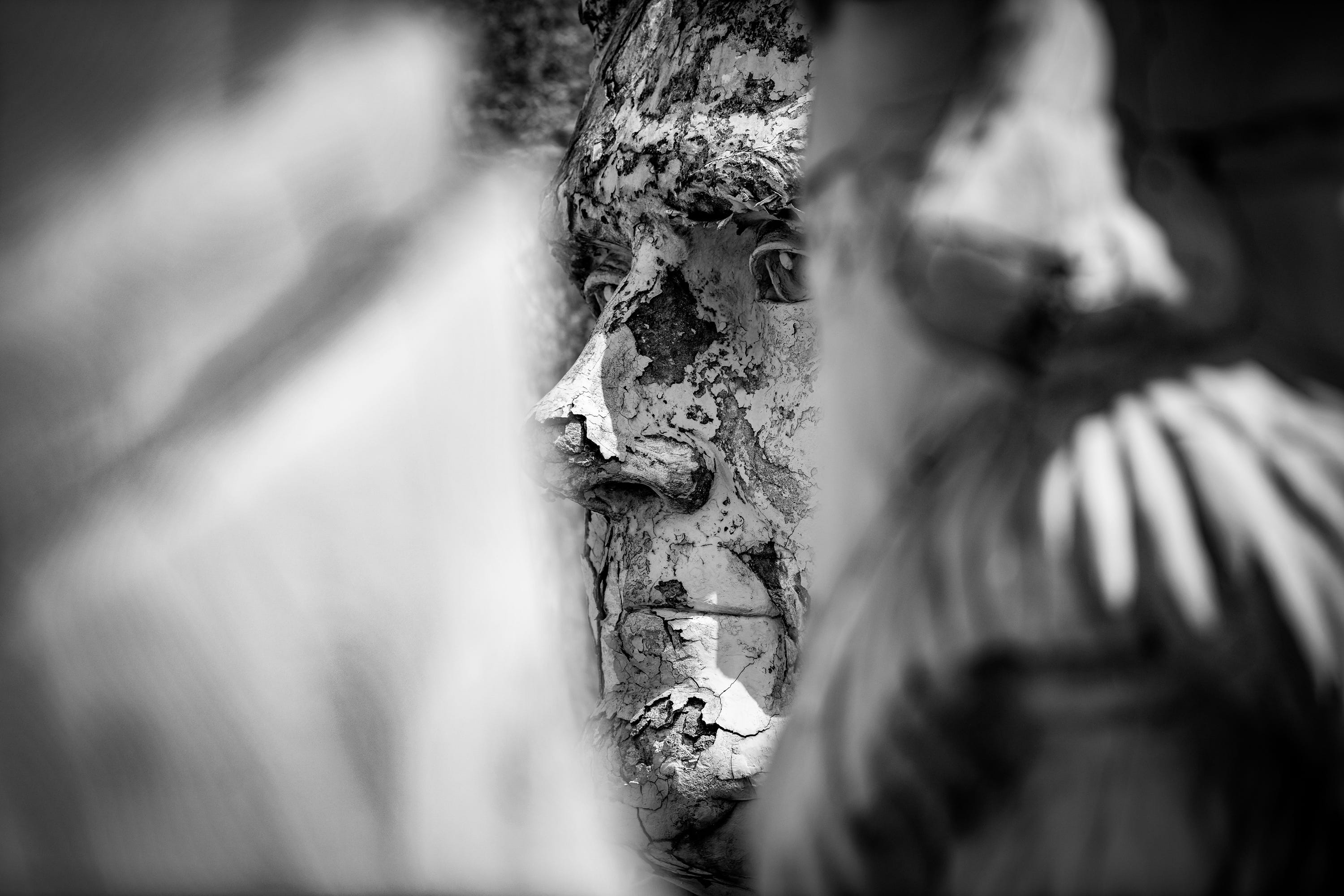
I had a moment standing between two 18-foot concrete presidents, mud so deep it almost seeped into my boots, camera raised, and afternoon light falling across cracked faces when I stopped thinking about composition and just felt the weight of a place I had dreamed of visiting for a long time.
That’s what happened to me in Williamsburg, Virginia last weekend.
I’d been planning this trip for a while. The Presidents Heads: 42 full-scale concrete sculptures of every president through George W. Bush once lived in a proper outdoor museum. That museum went bankrupt in 2010. The heads got moved to a private recycling facility, where they’ve spent the better part of fifteen years slowly surrendering to weather, moss, and time.
They’re not easy to visit. Google Maps list it as “Closed Permanently”. There is a “No Trespassing” sign at the end of the street.
You need a ticket. You need a specific weekend. You need rain boots.
You need to actually show up.
That last part is harder than it sounds.
For the last nearly 20 years, Heather and I have had the kind of schedule that makes spontaneity feel like a luxury. Soccer tournaments, regattas, choir concerts. But since becoming empty nesters, we have been blessed with flexibility. So when I received the notification that tickets were becoming available earlier this year I didn’t hesitate. I made a decision. I bought the tickets right away.
We left Cary at seven AM. The drive up to the site takes a little over three hours: long enough to decompress from the week, short enough that you arrive before the anticipation wears off. We talked the way you talk on drives like this. About the kids. Schedules. A story we hadn’t had a chance to tell each other that week. At some point the conversation turned to the sculptures themselves: How excited I was to check off a bucket list item, my thought process on which cameras and lenses I packed, what we expected, whether the photographs we’d seen online could possibly prepare us for the reality of standing next to something 18 feet tall and crumbling.
I packed two camera setups. The Nikon ZF with a 24-70 f/4 around one shoulder, the D850 with a 70-200 f/2.8 around the other. Double harness, both bodies ready. I’d spent time the night before thinking about how to work the space efficiently. We bought the VIP package which limited the amount of people to 15 in the one hour block. But that is only 1 hour with the sculptures before the hordes of people came into the area. This sounds like plenty of time until you’re standing in front of 43 sculptures in a tight muddy cluster trying to decide where to point a camera first.
My plan was to walk the full cluster once before shooting anything. Just look. Let the place tell me what it wanted.
That plan lasted about forty-five seconds.
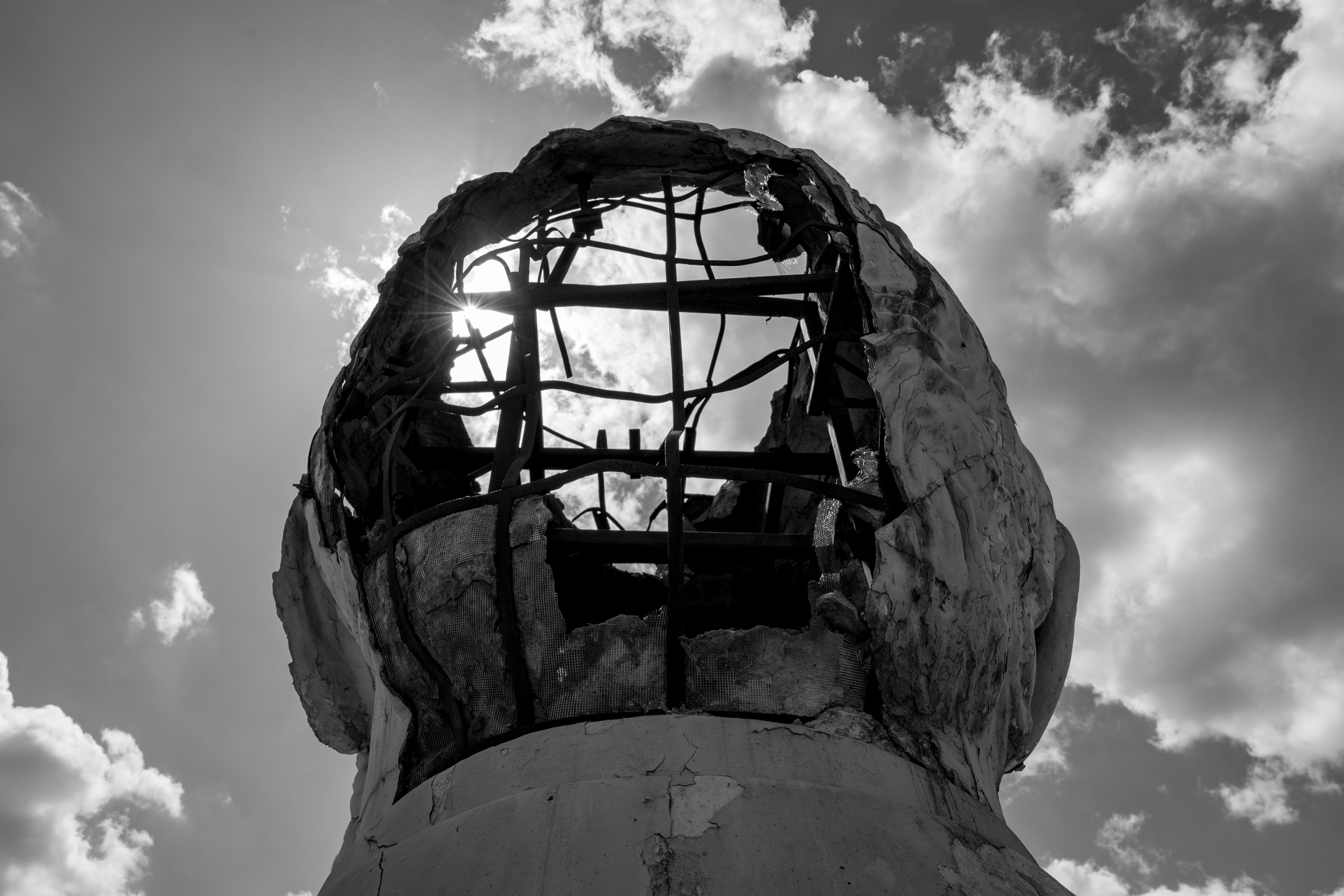
Power, it turns out, doesn’t keep well in concrete.
The sculptures are stranger in person than any photograph prepares you for. They sit in a tight cluster. Most of them pressed together like a crowd at a concert and with Washington, Jackson and Lincoln standing apart, watching from a distance. They’re crumbling. Moss climbs the cheeks of men who once ran the world. Cracks spider across foreheads. Entire sections of jaw and collar have given way to gravity and decay.
And yet they’re magnificent.
There’s something almost medieval about them. These massive, weathered faces emerging from overgrowth, stripped of the reverence we’re supposed to feel in the presence of presidents, returned to something rawer and more honest. Power, it turns out, doesn’t keep well in concrete.
The mud was real. The FAQ on the website had warned us (in all caps, twice) that rain boots were essentially mandatory. We’d heeded the warning. Good thing. The main cluster sits in standing water in places, and navigating it means committing to the mud, stepping in, moving through. There’s a metaphor in there somewhere about how the best things require you to get your feet dirty. I’ll leave it there.
I spent an hour in that cluster with my cameras, moving through it, looking up. The afternoon light was falling from the front. It was exactly the right angle for that time of day. And the concrete faces were reading beautifully. Shadow pooling in the eye sockets. The cracked surfaces catching the light in ways that made them feel geological, ancient, like something the earth had made rather than something humans had built and then abandoned.
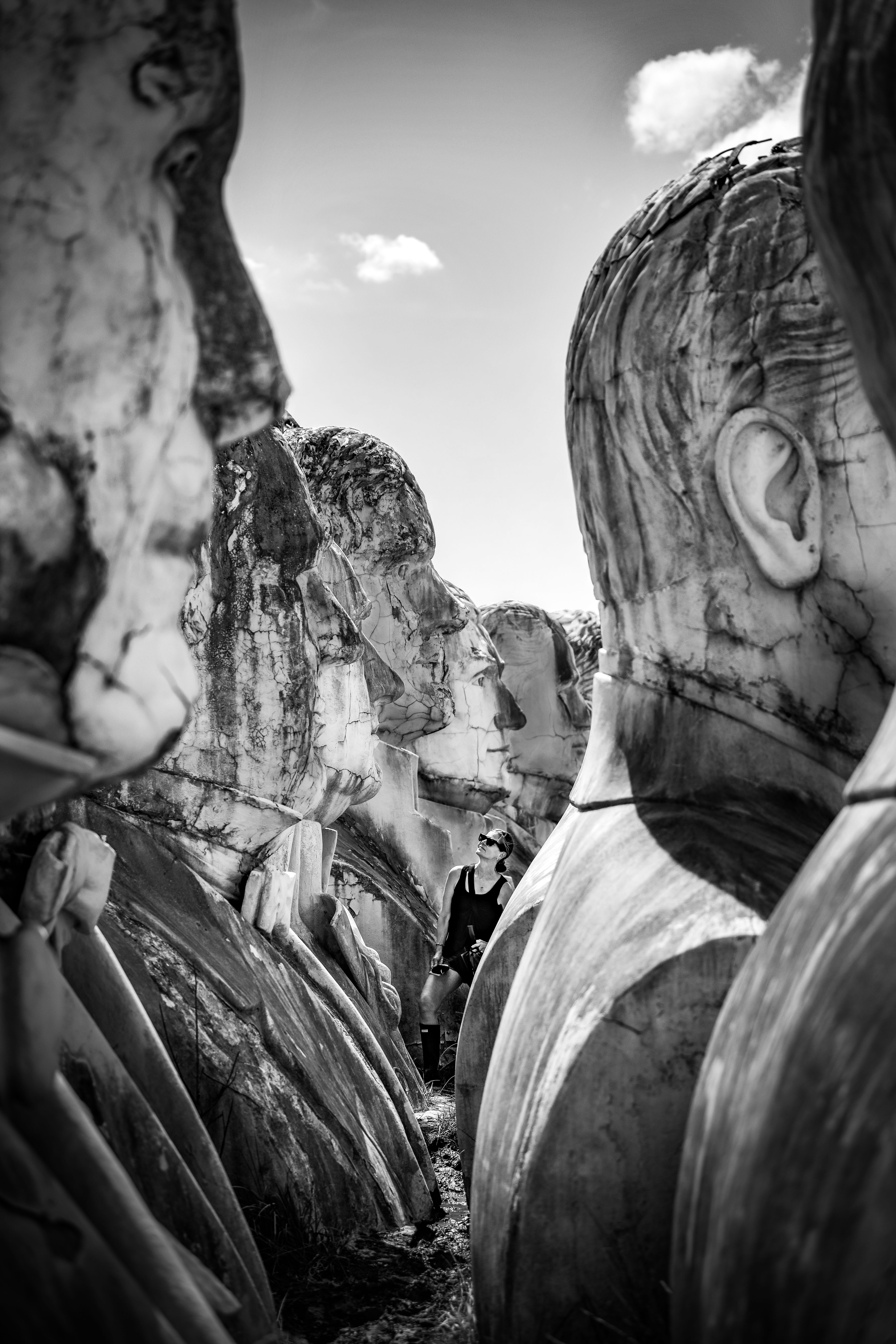
At some point Heather found her way between two of the heads and paused, tilting her face toward the sky. I raised the 70-200 and made one frame at 70mm, f/2.8, 1/5000th of a second.
I knew immediately it was the shot.
Memento Mori
I’ve been thinking about memento mori lately: the Latin reminder that we will die. Not in a morbid way. In the way that makes you buy the plane ticket, drive the extra hours, protect the open weekend on the calendar.
The Presidents Heads are their own version of this. These men were commemorated in concrete precisely because their legacies were supposed to outlast them. And here they are… cracking, mossy, half-forgotten in a Virginia recycling yard. They are almost more honest in their decay than they ever were in their glory. The monument intended to defeat time became a monument to time itself.
Monumento mori. The monument, too, will die.
I don’t find that depressing. I find it clarifying.
The future of the site is genuinely uncertain. The property could change hands. Access could disappear. What exists there right now? This strange, accidental, magnificent field of crumbling presidents? Well, it may not exist in the same form the next time I’d want to visit. I’m glad I didn’t wait to find out.
View more images and videos from this day on Instagram Gregory Ng
There’s something specific about photography and mortality. Every photograph is a small act of resistance against forgetting. You’re not stopping time. That’s not what a camera does, despite what we tell ourselves. You’re acknowledging it. You’re saying: this existed, this looked like this, I was here when it did. The shutter is less a freeze than it is a witness.
I’ve been making photographs seriously for a long time now. What I’ve learned (slowly, and mostly by accident) is that the photographs that matter aren’t the technically perfect ones. They’re the ones where something true was happening and you were paying enough attention to be in the right place when it did.
The image of Heather between the heads is like that. She was just moving through the same strange space I was, finding her own relationship to it, and for one 1/5000th of a second everything aligned. Her figure, the profiles in a row, the massive ear filling the right foreground, the cloud behind the middle heads…and the camera was already at my eye.
That photograph is a record of a real moment. It’s also a record of two people who decided to show up.
Both of those things matter to me equally. I am proud of how the photo turned out. But I am in love of the way it makes me remember this amazing time I got to share with her.
Life still leaning forward
There’s a particular satisfaction when the thing you anticipated turns out to be exactly as good as you hoped, and maybe a little better.
I’ve been adding things to bucket lists my whole adult life. Places to go, images to make, experiences worth protecting space on the calendar for. What I’ve noticed is that the list never actually gets shorter. You check something off and two more things appear. That used to feel like a problem. It doesn’t anymore.
The list isn’t a debt to be paid. It’s evidence of a life still leaning forward.
What I carried home was the photographs, obviously. But also something harder to name. I guess it’s a kind of recalibration. A reminder that the jampacked schedule is partly a choice, and that the open weekends don’t appear by accident. You have to protect them. You have to buy the tickets in January before the calendar fills in around them.
The sculptures will keep crumbling.
That’s not tragedy. It’s physics.
What matters is that on one April afternoon, with the light falling right and the mud doing its best to swallow my boots, I was there to see them.
We both were.
The photograph is going on my office wall. 24 inches by 36 inches, giclee on matte paper. The image at full scale. Heather between the heads, looking up, impossibly small against all that concrete ambition.
I’ll look at it every day. I want to.
This is not a reminder that things decay. I don’t need the reminder. But as a record that on one April afternoon, with mud on my boots and cameras around my neck, I showed up for something.
That’s the whole thing, really. The calendar will always be full. The weekends will always be limited. The places worth visiting will not always wait.
Go anyway.
Until then, stay curious about the people you already know.